
ICDC Conference 2026: Creativity and entertainment as essential tools in countering disinformation
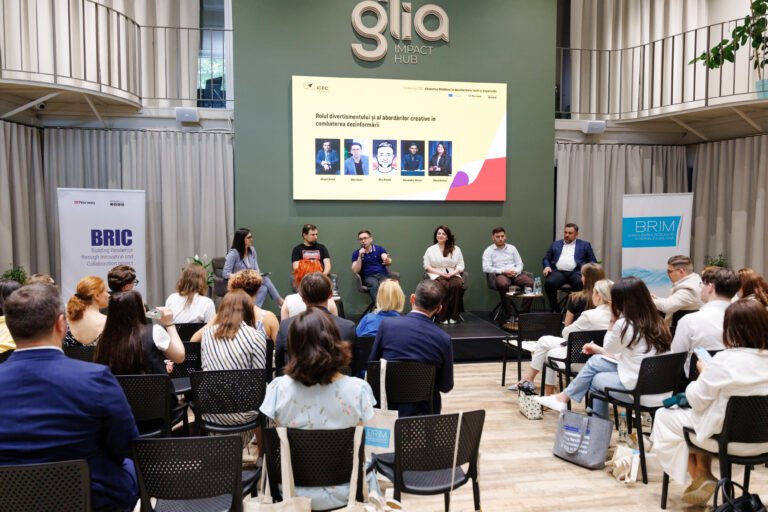
Entertainment, humor, storytelling, and content tailored to digital platforms can become powerful tools for countering disinformation and reaching audiences that increasingly avoid traditional media formats. This was one of the main conclusions of the second panel of the ICDC Conference, ”Moldova’s response to disinformation: insights from practice”, titled “Entertainment and creative approaches to countering disinformation.”
Journalists, content creators, cartoonists, and activists emphasized that accurate information must reach people through the formats they consume every day, without compromising quality or accuracy.
Journalist Alex Cozer noted that television continues to play an important role, but it must also maintain a strong online presence to remain relevant. “The role of journalists will remain extremely important, regardless of how much ground the online space gains. But we must realize that if we do not stay active and present online, we will lose that space as well,” he said.
Content creator Elena Briciuc called for greater engagement from those producing high-quality content on the very platforms where manipulative narratives spread most actively. “Go to TikTok. Don’t let those spreading nonsense be the loudest voices. Let’s be the ones people hear,” she urged, stressing that audiences must be reached where they consume information.
Mihail Sirkeli, founder of the Nokta news portal, explained that simply presenting the news is not enough to counter propaganda. According to him, audiences also need entertainment content capable of conveying social and civic messages. “We need to offer an alternative. People cannot spend all their time watching talk shows and political programs. They also need entertainment,” he said.
Cartoonist Alex Buretz highlighted that illustrations and satire can make complex information more accessible and easier to share. At the same time, he warned that these tools can also be exploited for manipulation, including through images generated by artificial intelligence.
Content creator Alexandru Ghețan shared his experience using infotainment formats to engage young audiences. He explained that messages must be adapted to the language and platforms preferred by different audience groups. “Ordinary people need things to be explained in their own language,” he said, adding that the fight against disinformation cannot be occasional: “Propaganda operates continuously, so our response must also be continuous.”
The discussion also underscored the importance of building trust between communities, including between residents on both banks of the Nistru River and across the different regions of the Republic of Moldova. Participants stressed that bringing people closer together requires shared stories, dialogue, and content that highlights common experiences and values rather than divisions.
The panel concluded that, in an information environment dominated by digital platforms and intense competition for public attention, creativity, humor, and audience-tailored content are not merely effective communication methods but essential components of efforts to strengthen society’s resilience against disinformation.
Trending Post
CICD (c) 2024