
How the information is manipulated in the Republic of Moldova and what the latest disinformation report reveals
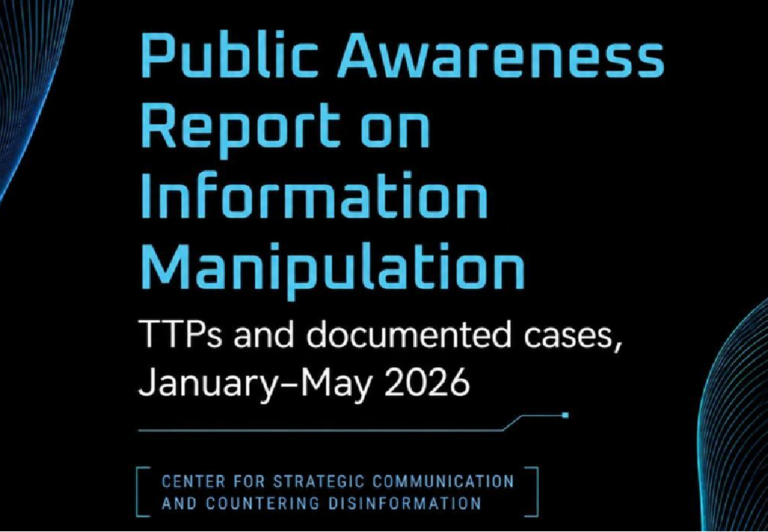
Disinformation in the Republic of Moldova is no longer limited to the occasional spread of false news. It has evolved into a complex phenomenon fuelled by coordinated networks of fake accounts, cross-platform influence campaigns, and the AI-based toolsused to amplify manipulative narratives. These are the key findings of the latest report published by the Center for Strategic Communication and Countering Disinformation, which examines the mechanisms used to manipulate information with the aim of influencing public opinion in the Republic of Moldova.
The report shows that the actors behind these campaigns seek to create the illusion of widespread public support for specific narratives by using inauthentic accounts and coordinated content distribution. On Facebook alone, researchers identified 175 fake accounts, while on TikTok they analyzed 259 accounts with a combined audience of more than 532,000 followers. Between 1 January and 14 April 2026, these accounts published approximately 14,370 posts, generating more than 115 million views.
The report also highlights how information manipulation is rapidly adapting to the characteristics of each platform. While Facebook is primarily used to simulate public support through networks of fake accounts, TikTok relies on short, highly emotional videos designed to reach large audiences quickly. At the same time, online polling platforms, foreign media outlets, and AI-generated content are used to give the promoted narratives an appearance of credibility..
The topics exploited are both sensitive and recurring, including migration, national identity, religion, local autonomy, and European integration. Real issues are reframed and presented in an alarmist manner to amplify fear, distrust, and social polarization.
One example highlighted in the report is the campaign built around the claim that the Republic of Moldova was preparing to receive “300,000 migrants.” According to the analysis, this narrative was amplified in a coordinated manner across multiple platforms and transformed into an alarmist story about an alleged “replacement of the population,” the loss of national identity, and threats to national security. Rather than presenting fact-based information, the campaign exploited public fears and emotions to generate distrust and deepen social divisions.
Another example concerns the French publication Omerta, which was used to promote anti-government narratives about the Republic of Moldova. According to the report, the outlet portrayed the country as a state controlled from abroad and a “geopolitical laboratory.” These articles were subsequently republished and circulated within Moldova’s information space as supposedly independent confirmation from the Western press. The report concludes that this technique is intended to provide hostile narratives with an appearance of external credibility and may influence both domestic public opinion and the Republic of Moldova’s image across Europe.
The impact of these campaigns extends well beyond the online environment. By systematically promoting messages that portray state institutions as incompetent or controlled by foreign actors, and by presenting European integration as a threat, these manipulation campaigns seek to undermine public trust in democratic institutions and reform processes.
The report’s findings confirm that disinformation remains a major challenge to the Republic of Moldova’s information resilience and underscore the need to strengthen society’s ability to identify and counter information manipulation. For a comprehensive overview of the mechanisms, narratives, and techniques examined, read the full report here.
Trending Post
CICD (c) 2024