
ICDC Conference 2026: Cohesion and trust, identified as key pillars in countering disinformation in Moldova
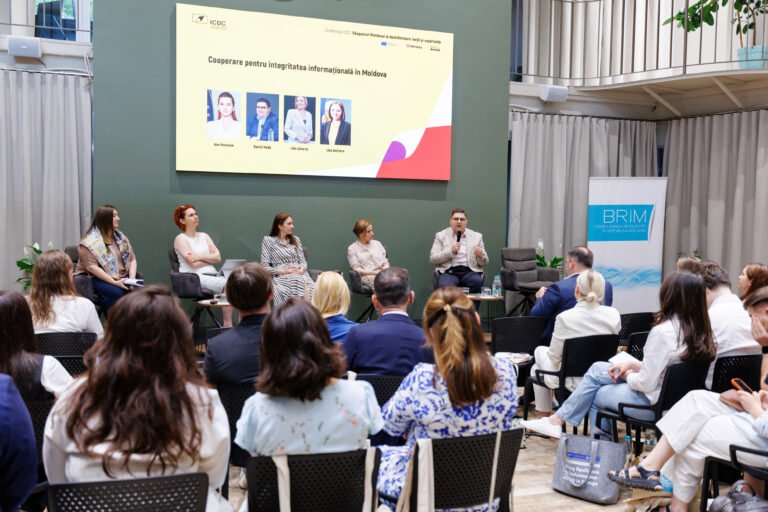
Strengthening social cohesion, building trust between citizens and institutions, and engaging local communities were identified as some of the most important conditions for increasing Moldova’s resilience to disinformation during the first panel of the ICDC Conference ”Moldova’s response to disinformation: insights from practice”, titled ”Working together toward information integrity in Moldova”.
Opening the discussion, Ana Revenco, Head of the Center for Strategic Communication and Combating Disinformation (StratCom), stressed that the Republic of Moldova has made significant progress in coordinating efforts to counter foreign information interference, but warned that manipulation tactics are constantly evolving. According to her, today’s information environment is increasingly dominated not by obvious fake news, but by subtle forms of manipulation designed to deepen social divisions.
“We need to stay prudent,” she said, urging both institutions and civil society to constantly ask themselves: “What is the purpose behind this public debate?” She emphasized that social cohesion and consensus around common strategic objectives should become “a key component of the state’s security configuration.”
The discussion also highlighted that resilience cannot be built through institutions alone. Lina Botnaru, representing the European Union Delegation to the Republic of Moldova, noted that many citizens struggle to keep pace with ongoing reforms and often fail to see how these changes relate to their own lives. She underlined that future EU support will continue to prioritize projects that strengthen social cohesion, strategic communication and independent media.
The importance of local communities was echoed by Lilia Zaharia, who presented findings from Transparency International Moldova’s outreach activities in ten districts. According to her, local opinion leaders, including mayors, priests, school directors and community leaders, often become the primary source of both information and manipulation.
“People are not stupid. People are disinformed and manipulated by those who are interested in passing on such messages,” she said, arguing that authorities and civil society need to engage directly with communities instead of relying solely on communication from the capital.
Former government spokesperson Daniel Vodă also emphasized that public trust depends on direct interaction with citizens. “If we are not present in the community, if we don’t discuss at the grassroots with mayors, doctors, priests, with everybody, there will be someone else who will tell our story instead of us,” he warned.
The panel concluded that combating disinformation requires more than fact-checking or reacting to false narratives. Speakers repeatedly stressed that trust is built through consistent action, dialogue and community engagement. As Ana Revenco summarized, “Strategic communication does not replace actions. Strategic communication means actions that build trust.”
Trending Post
CICD (c) 2024