
International Journalism Festival: Moldova’s democratic resilience in the face of Russia’s information war
In the run-up to Moldova’s crucial September 2025 parliamentary elections, the country became a frontline in Russia’s information war. Kremlin-aligned narratives flooded television, social media, and messaging apps, aiming to undermine trust in democracy, European integration, and state institutions.
Yet the outcome showed that coordinated democratic resilience can limit the impact of foreign interference, even under severe pressure.
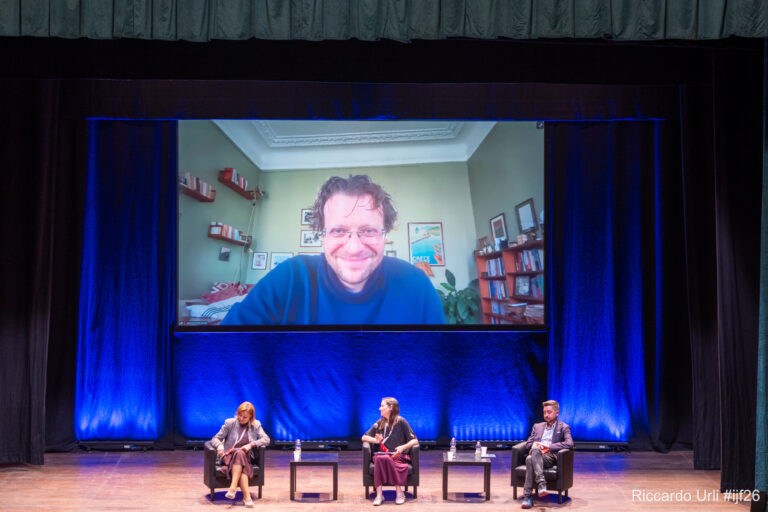
A panel discussion at the Perugia International Journalism Festival titled “How Moldova won: a case study on defeating Russia’s disinformation war”, examined how a coordinated response by journalists, civil society, and institutions helped contain one of the most aggressive disinformation campaigns in Eastern Europe.
Moderated by Daniella Peled, managing editor at the Institute for War and Peace Reporting, the discussion brought together key voices including Valeriu Pașa, founder and chairman of WatchDog.md, Peter Pomerantsev, senior fellow at Johns Hopkins University, and Lilia Zaharia Cravcenco, executive director of the Transparency International–Moldova.
“Moldova has become a frontline in Russia’s war against European values and democracy,” Peled said, describing the elections as pivotal for the country’s future.
Russia deployed a mix of tactics, from coordinated online manipulation to illicit financing, vote-buying schemes and influence networks, flooding digital platforms with misleading content. But, as Peled noted, “against this hybrid war came a hybrid fightback.”
A coalition of independent journalists, civil society organisations, and public institutions responded with a coordinated strategy: investigative reporting, pre-bunking and real-time debunking, media literacy efforts, and evidence-based institutional actions. Despite limited resources and intense political pressure, this alignment proved critical.
Despite these pressures, the pro-European Party of Action and Solidarity retained a parliamentary majority, allowing Moldova’s EU accession course to continue.
A key factor in Moldova’s resilience was the role of investigative journalism. According to Pomerantsev, Moldovan reporters did more than react – they anticipated.
“What was remarkable is that investigative journalists at outlets like Ziarul de Gardă identified months in advance the Russian networks preparing vote-buying schemes,” he said. “They infiltrated them and operated with the efficiency of an intelligence agency, while doing journalism.”
This proactive approach helped expose coordinated influence operations before they could fully unfold, limiting their impact on voters and giving citizens, civil society and public authorities more time to respond.
Speakers also stressed that Moldova’s success came with hard lessons learned from earlier setbacks.
“We succeeded because we made countering foreign interference a priority,” said Pașa. Reflecting on the narrow outcome of the 2024 referendum, he noted that earlier efforts focused heavily on monitoring adversaries, but delivered limited results.
“The lesson was clear: if we focus too much on what the adversary is doing, we risk getting lost in endless analysis,” he explained. “We may end up understanding their tactics better than they do, but without actually responding. The shift was towards telling our own story more effectively.”
This recalibration – from reactive monitoring to proactive communication – proved decisive in strengthening public resilience and preventing hostile actors from defining the public agenda.
The discussion also raised a fundamental challenge: how can democratic systems respond effectively to non-democratic tactics?
“What is the democratic response to corruption, sabotage, and vote-buying?” Pomerantsev asked. “We are expected to respond with the tools of democracy, so the question is how to sharpen those tools.”
Traditional journalism alone, he argued, is no longer sufficient. Moldova’s response instead relied on a broader ecosystem: investigative media, NGOs working on pre-bunking and public engagement, academics analysing narratives, and law enforcement acting early and based on evidence.
This coordinated model, he suggested, represents a new methodology for defending democratic processes.
“We often assume others should learn from Western Europe,” Pomerantsev noted. “But in this case, it’s clearly the other way around.”
As elections worldwide face growing foreign interference, Moldova offers what Peled described as a “rare good news story” – a small country successfully resisting a powerful external actor.
“It’s important to recognise this as a success,” she said. “We should celebrate it—and we should learn from it.”
You can watch the full discussion here: https://www.youtube.com/watch?v=wpbuQr1_J2w
Trending Post
CICD (c) 2024