
4th EEAS FIMI report: Moldova on the frontline of information warfare
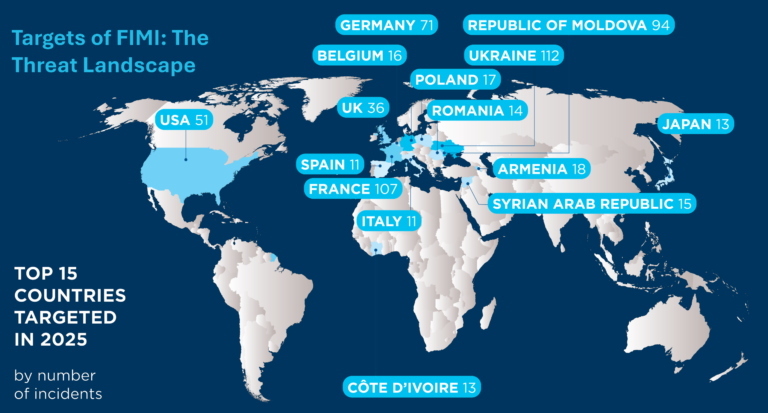
Moldova is increasingly on the frontline of a new kind of warfare, one fought not with weapons, but through the manipulation of information. The 4th European External Action Service (EEAS) report on Foreign Information Manipulation and Interference (FIMI), published in March 2026, shows that the country has become a key target of such activity, particularly in the context of its EU accession path and recent elections.
As EU High Representative Kaja Kallas notes, “the information space is a frontline in the fight for democracy.”
In 2025, Moldova was among the most targeted countries globally. According to EEAS, Ukraine remained the primary target, followed by France, Moldova and Germany. Its parliamentary elections were met with an “unprecedented wave” of hybrid threats combining disinformation, digital manipulation, and coordinated online campaigns.
These operations are not ad hoc. The EEAS presents them as structured and repeatable campaigns, with Russian FIMI activity playing a central role in election-related interference. Their purpose is to shape public opinion, weaken trust in institutions, and influence political outcomes.
Interference becomes most visible during elections, where a repeatable three-stage pattern emerges: discrediting leadership months in advance through allegations of corruption or foreign control; exploiting social divisions during the campaign, including economic concerns, protests, and fears of war; and, finally, undermining trust in the electoral process itself close to voting day. In Moldova, these tactics targeted President Maia Sandu and Prime Minister Dorin Recean, while also promoting alternative political options.
A defining feature of recent FIMI activity is the growing use of artificial intelligence. In 2025, one in four incidents detected by EEAS involved AI tools used to produce or distribute text, images, and videos at scale. In Moldova, such content was used to impersonate individuals and spread misleading claims, reflecting a broader trend towards mass production and saturation. Social media platforms play a central role: during the elections, TikTok alone removed over 13,000 inauthentic accounts involved in coordinated campaigns used to discredit the government and amplify pro-opposition narratives.
These campaigns focused heavily on political leaders and identity-related issues, promoting narratives that leaders are controlled by the EU or NATO, are corrupt, or are undermining national sovereignty, often framed through fears that Moldova could lose sovereignty to Romania. Other narratives targeted traditional values, including gender and LGBTQ+ issues. Together, these messages aim to deepen divisions and frame political choices as struggles over identity, sovereignty and national survival.
Moldova is not an isolated case. The same tactics used during its 2025 elections are now being replicated in Armenia ahead of its 2026 elections, demonstrating that FIMI is organised, scalable, and transferable across countries. The EEAS stresses that it must be treated as a security issue, not just a communication challenge, requiring faster responses, stronger international cooperation, and efforts to disrupt the networks behind it. At the same time, strengthening societal resilience, through media literacy, awareness, and trust in institutions, remains essential.
Moldova remains on the frontline of modern information warfare. As the country continues its European path, it will likely remain a key target of foreign interference. The question is therefore not only the scale of the threat, but the country’s preparedness to detect, resist and respond to it.
The full EEAS report is available here:
https://euvsdisinfo.eu/eeas-4th-fimi-threat-report-march-2026/
Trending Post
CICD (c) 2024