
ICDC Regional Learning Call highlights growing threat of gender disinformation to women’s political participation
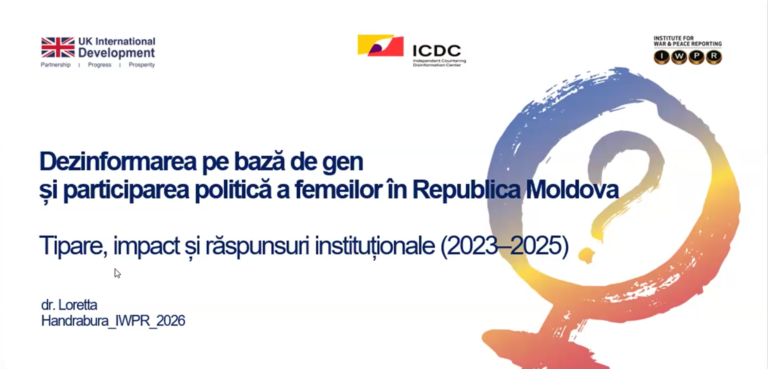
On 24 March 2026, the Independent Countering Disinformation Centre (ICDC) hosted a regional learning call on gender-based disinformation and its impact on women’s political participation. The online event brought together experts, civil society, media, and international partners to exchange insights and explore responses to this growing challenge.
The session featured two complementary presentations combining research-based analysis and AI-driven monitoring tools to better understand gender disinformation.
Dr. Loretta Handrabura presented the IWPR guidebook “Gender-Based Disinformation and Women’s Political Participation in Moldova”, which compiles research, key findings, and practical recommendations to better understand gender disinformation and how institutions, media, and civil society can respond effectively. The guide was shared with all participants following the session.
Presenting the guidebook, Dr. Handrabura emphasized the broader democratic impact:
“Gender-based disinformation alarmingly affects women’s political participation in the Republic of Moldova. The guide covers a wide range of aspects, from public policies that form the foundation of a participatory and inclusive democracy to the role of media and civil society in ensuring the inclusion and participation of a majority that is still not represented as such – and here I am referring to women.”
The findings show that gendered disinformation targets women in public life through stereotypes, personal attacks, and emotionally charged narratives, particularly during elections. The guide outlines key priorities, including protecting women from online attacks, reducing the spread of disinformation, and enabling meaningful political participation.
In the second session, Anselm Bareis (GIZ Info Trust Alliance) introduced an AI-supported dashboard developed to monitor gendered disinformation across platforms such as Telegram and TikTok. The tool tracks narratives, patterns, and trends, supporting research and evidence-based responses. Access to the dashboard was also shared with participants, who were invited to test and contribute to its further development.
Bareis noted the scale and normalization of the phenomenon:
“It’s really incredible how much disinformation, misinformation, and hate speech you find online in Moldova. It’s everywhere – and we’ve got used to it.”
He also highlighted that online attacks are often not random, but coordinated:
“What sometimes seems like a spontaneous outburst is often not spontaneous – it’s coordinated, and the board we developed helps to monitor these patterns.”
Together, the two presentations illustrated how combining analytical research with data-driven monitoring can strengthen responses to gender disinformation.
Participants highlighted that such narratives undermine democratic processes by discouraging women’s participation and distorting public debate. Strengthening cooperation, improving monitoring, and promoting media literacy were identified as key responses.
The session concluded with a shared commitment to continued collaboration to counter gender-based disinformation and support inclusive political participation across the region.
Trending Post
CICD (c) 2024