
Poll: Interest in the reintegration of the Republic of Moldova is growing in the Transnistrian region
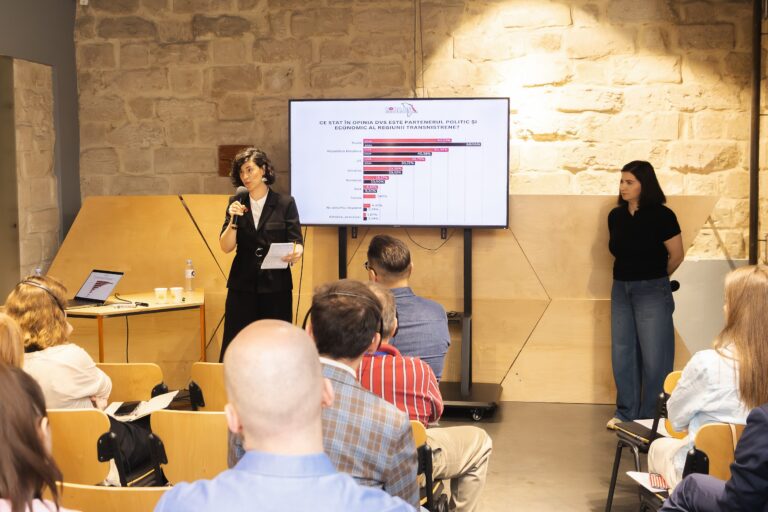
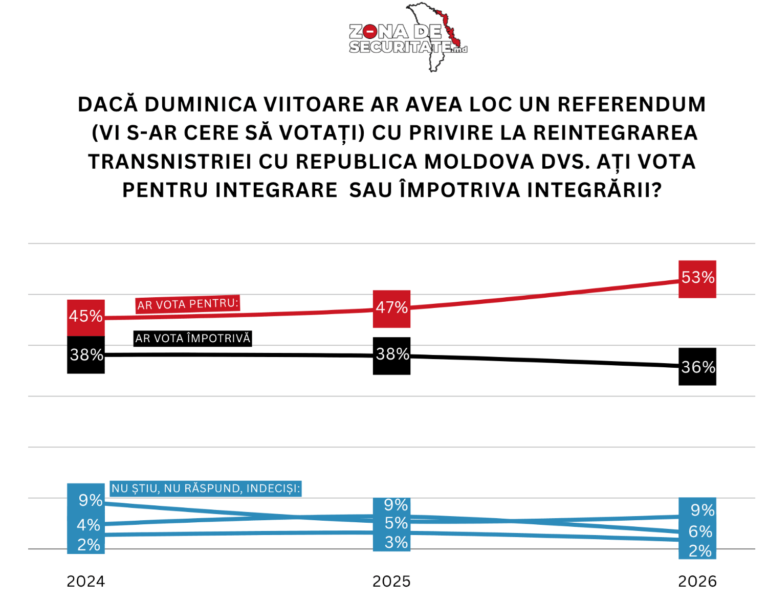
A new study presented on May 26 by Zona de Securitate and the WatchDog.MD community reveals a significant shift in public perceptions in the Transnistrian region. According to the research, support for the reintegration of the two banks of the Nistru River is increasing, with every second resident of the region supporting this option. For the first time in the past three decades, closer ties with the right bank of the Nistru are seen as being just as important as relations with the Russian Federation.
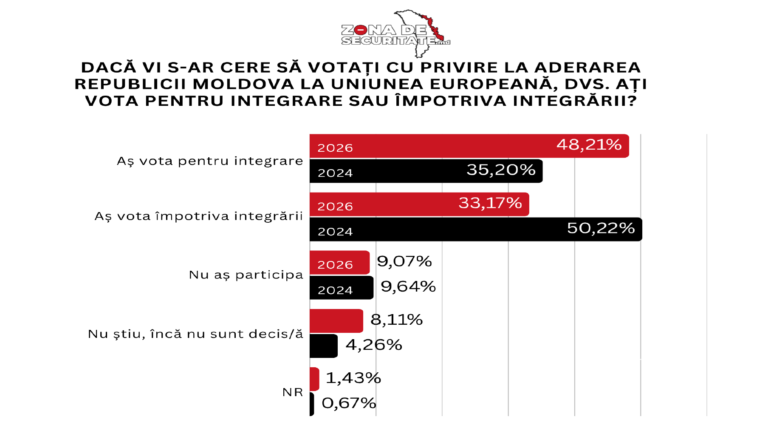
At the same time, support for the Republic of Moldova’s accession to the European Union has risen to over 48%, indicating that more and more people associate their future with stability and a normal life rather than with geopolitical projects.
The study was based on an anonymous online survey conducted between February and April 2026, involving a sample of 419 respondents from the five districts on the left bank of the Nistru. The research was complemented by six focus group discussions with a total of 47 participants. Overall, the findings provide valuable insight into how people in the region view the future amid insecurity, economic pressures, and the ongoing consequences of Russia’s war against Ukraine.
Tatiana Cojocari, sociologist and coordinator of the study, says that policymakers should not ignore these findings.
“All policies developed in the Republic of Moldova should be based on sociological data. Policies must be shaped around people’s needs,” she argues.
In her view, a more targeted communication strategy for the population on the left bank is needed, and such an approach should form part of broader efforts to counter Russian disinformation, given the region’s high vulnerability to propaganda and misinformation.
The study also shows that, despite ongoing political differences and mutual suspicions, everyday realities are driving people toward pragmatic cooperation. Residents of the left bank want their voices to be heard and are calling for concrete solutions related to employment, healthcare access, and more accessible citizenship procedures. Their message is clear: they want to be treated as part of the same state and to enjoy the same rights.
The research is part of a three-year monitoring effort. It is the third consecutive study conducted by Zona de Securitate and WatchDog.MD in the Transnistrian region, following similar surveys carried out in 2024 and 2025. This continuity makes it possible to identify long-term trends and changes in public attitudes rather than providing only a snapshot of a particular moment.
In this context, the study by Zona de Securitate and WatchDog.MD captures not only a shift in public opinion but also an important political opportunity. If these trends are properly understood and translated into public policies that reflect the realities on both banks of the Nistru, the process of bringing communities closer together could become more meaningful and credible in the years ahead.
Trending Post
Russian FIMI in Moldova: Why resilience matters more than censorship
CICD (c) 2024