
Civil society resilience against disinformation: Experts call for stronger cooperation and proactive responses to hybrid threats
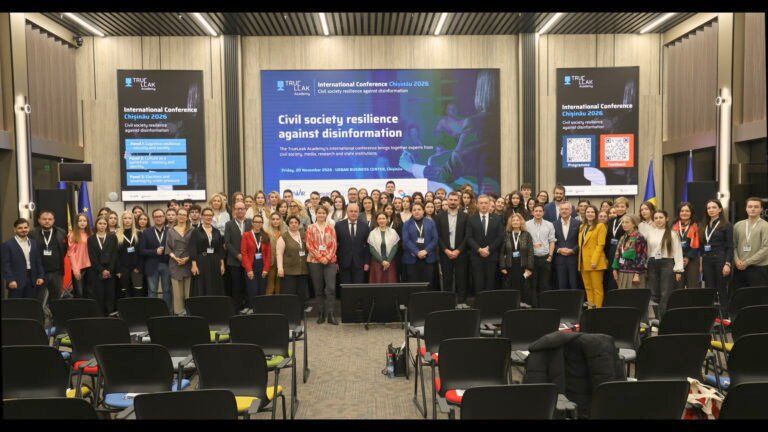
Disinformation is increasingly used as a strategic weapon to erode public trust, deepen social divisions, and influence democratic decisions. That was the central warning at “Civil Society Resilience Against Disinformation,” an international conference in Chișinău organised by Watchdog.md and German-Ukrainian Impact (DUWir) on 20 November, bringing together policymakers, security experts, and civil society leaders from Moldova, Ukraine, Germany, and Poland.
Michael Roth, former Minister of State for Europe at the German Federal Foreign Office, illustrated the human cost of foreign information manipulation and interference (FIMI) through a conversation with a 22-year-old taxi driver in Chișinău who had given up on politics, saying he no longer trusted politicians, institutions, or the media. Roth linked this apathy to a deliberate strategy of flooding audiences with contradictory narratives until facts become indistinguishable from manipulation. He argued that this tactic requires transparency, independent media, honest communication, and education to counter.
Andrei Curăraru, co-founder of Watchdog.md, highlighted four vulnerabilities exploited during recent Moldovan elections: AI-driven disinformation, the manipulation of identity and religion, vote-buying tied to economic hardship, and the amplification of social divisions. Warning that cognitive threats are now as consequential as conventional security risks, yet far cheaper to scale, he called for a whole-of-society defence.
Polish security expert Kamil Basaj urged participants to look beyond isolated fake accounts, comparing modern Russian influence campaigns to Soviet-era KGB active measures that blend online propaganda with intimidation and sabotage. In Poland alone, researchers have uncovered over 270 websites linked to pro-Russian networks seeking to weaken support for Ukraine and fuel anti-Western sentiment. “Security is a process. It’s not a moment that you can simply achieve,” Basaj said, urging civil society to move beyond reactive fact-checking towards proactive investigation and public communication.
Liliana Vițu, Head of Moldova’s Centre for Strategic Communication and Combating Disinformation (StratCom), warned that while foreign interference is well-funded and increasingly automated by AI, democratic responses remain fragmented. “National resilience is not just the responsibility of StratCom,” she stressed, calling on civil society, independent media, and academia to meet citizens where they actually consume news, especially on platforms like TikTok.
Participants concluded that countering hybrid threats means addressing genuine economic and social grievances alongside digital manipulation, reinforcing both Moldova’s stability and wider European democratic security.
Trending Post
CICD (c) 2024