
What makes us vulnerable to disinformation: key insights from the Soros Foundation Moldova workshop
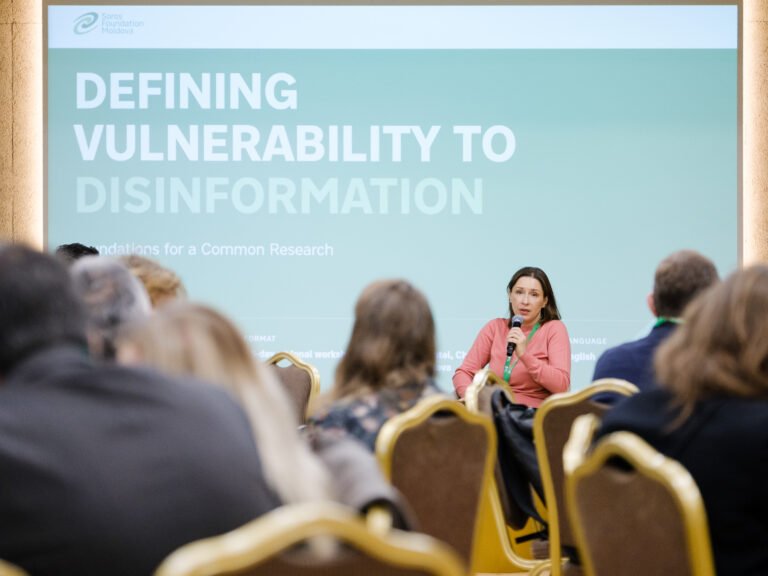
Why are some communities more vulnerable to disinformation, and how do foreign actors exploit existing social tensions and grievances? These questions were at the heart of the regional workshop “Defining Vulnerability to Disinformation”, organised by Soros Foundation Moldova on Monday, 26 October 2026, bringing together experts and civil society representatives from the Republic of Moldova and other European countries.
A central theme of the discussions was how information manipulation exploits existing social problems, including distrust in public institutions, political polarisation and economic insecurity. These vulnerabilities can be exploited to intensify social tensions and influence public perceptions.
The discussions also highlighted the role of digital platforms in spreading and amplifying manipulative content, particularly TikTok and Telegram. As TikTok grows in popularity, the limited transparency of its recommendation algorithms makes it more difficult to monitor how certain messages circulate and reach large audiences.
In the case of Telegram, participants examined campaigns targeting specific communities and regions, including Gagauzia and the Transnistrian region. Through dedicated channels and groups, hostile actors can promote narratives tailored to local concerns, such as claims that central authorities are harming regional economies or attempting to restrict local autonomy.
Participants also highlighted the difficulties encountered in securing cooperation from major digital platforms. In the Republic of Moldova, one challenge is limited access to the oversight and enforcement mechanisms established under European Union legislation, including the Digital Services Act (DSA).
Understanding disinformation goes beyond identifying individual false claims and fact-checking them. Foreign information manipulation and interference (FIMI) can exploit the social and political vulnerabilities of specific communities. When people feel that democratic institutions are failing to address their everyday concerns, public trust can decline, creating favourable conditions for manipulative messages to spread.
Research findings discussed during the workshop suggested that disinformation often reinforces existing beliefs, fears and prejudices rather than radically changing people’s opinions overnight. Manipulative messages can also spread through seemingly apolitical content, including entertainment, films and lifestyle-related material.
The emotional dimension of manipulation was also addressed, particularly how political campaigns can exploit public fears related to economic hardship, tax increases and political instability. Appeals to fear can influence how people interpret events and respond to political messages.
Participants also examined how effectively independent media outlets and civil society organisations reach audiences exposed to disinformation. Limited financial and human resources in many independent newsrooms make it difficult to maintain a consistent presence on platforms such as TikTok and Telegram. As a result, some audiences may be exposed to manipulative narratives without having sufficient access to information from independent media on the same platforms.
Another topic was the effectiveness of fact-checking after false information has already spread. In certain circumstances, repeating a false claim in an attempt to debunk it can inadvertently increase its visibility. For this reason, participants highlighted the importance of prebunking, an approach that helps people recognise manipulation techniques before encountering misleading messages. Strengthening the presence of independent journalism on platforms used by different communities was identified as another important priority.
One of the workshop’s central conclusions was that understanding disinformation begins with understanding the society in which it circulates. Public grievances, fears and distrust can create fertile ground for manipulation. Addressing these vulnerabilities requires strengthening public trust, developing independent media capable of reaching exposed communities, and establishing more effective mechanisms for holding digital platforms accountable.
Trending Post
CICD (c) 2024