
Combating FIMI starts at the local level: key conclusions from the CORLEAP meeting in Chișinău
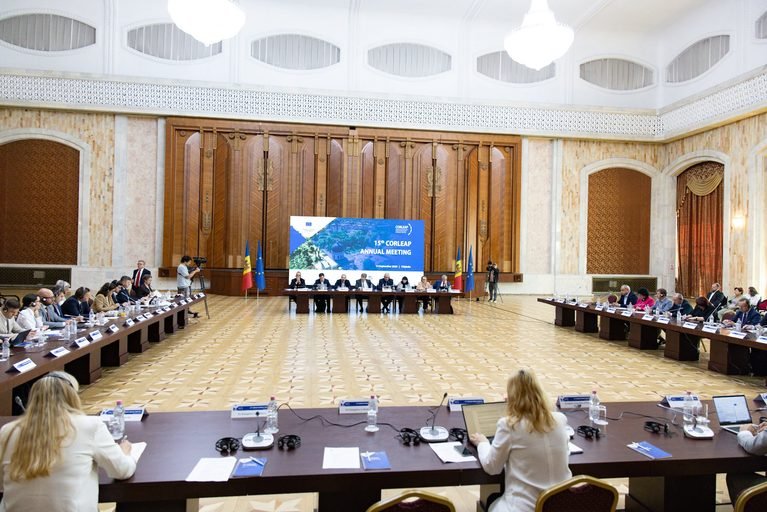
Countering foreign information manipulation and interference (FIMI) does not mean less democracy. It requires transparent communication, independent local media, and cooperation between authorities, civil society, and the media. This was one of the main conclusions of the 15th annual meeting of CORLEAP, held in Chișinău, bringing together representatives of local and regional authorities, European institutions, and Eastern Partnership countries.
Government Secretary-General Alexei Buzu stressed that vulnerability to manipulation also has a social dimension. He identified three feelings that make people more vulnerable: a lack of a sense of belonging to a community, the perception that no one is standing up for them, and a sense of powerlessness.
Participants discussed foreign information manipulation and interference (FIMI) as a significant challenge to the resilience of local communities. Marcel Spătari, Chair of the Parliament’s Committee on Economy, Budget and Finance, stressed the need for cooperation among institutions, the media, civil society, and local authorities, while respecting freedom of expression and supporting independent media. “We cannot counter manipulation simply by prohibiting everyone from speaking,” he said.
Another important message was that efforts to prevent manipulation need to begin before existing vulnerabilities are exploited. Liliana Vițu-Eșanu, Director of the Centre for Strategic Communication and Countering Disinformation (STRATCOM), noted that “a reform that is insufficiently explained leaves room for others to explain it instead of the state,” stressing that the response to FIMI should focus on protecting democratic and electoral processes, rather than simply reacting to false information.
The discussions also highlighted vulnerabilities specific to local communities. Poor and depopulated rural areas, as well as young people who are not in employment, education or training (NEETs), may be particularly vulnerable to disinformation and information manipulation. “Poverty is a vulnerability exploited at the local level. The Șor network began with victories in local elections in small communities,” said Eugen Muravschi, an expert at WatchDog.MD. He also stressed that Russian propaganda seeks to undermine trust in democracy: “Ideally for Russia, when a citizen is asked about politics, they will answer: ‘I’m not interested in politics.’”
Participants also addressed the use of artificial intelligence to produce and amplify manipulative audio and visual content, as well as cyberattacks targeting local public infrastructure. During the meeting, Marcel Spătari referred to data attributed to the European External Action Service indicating that, in September 2025, TikTok had at least 31,000 accounts generating AI-based content which, he said, had affected the electoral process.
On the practical side, discussions focused on strengthening the capacity of local and regional authorities and promoting the exchange of experience and good practices between authorities in the European Union and their counterparts in Eastern Partnership countries. The meeting also saw the launch in Chișinău of the pilot Eastern Partnership Academy for Public Administration at Local and Regional Level (EPAPA), aimed at strengthening the capacities of local and regional public administrations.
The role of local and regional media in informing communities and strengthening local resilience was also highlighted. In Moldova, the project competition under the Media Subsidy Fund has been allocated a total budget of MDL 20 million for 2026.
One of the central messages of the meeting was that information resilience is also built at the local level: through trust, institutional presence, credible public communication, and an independent and sustainable local media ecosystem.
Trending Post
Russian FIMI in Moldova: Why resilience matters more than censorship
CICD (c) 2024