
Fractured reality: how democracy can win the global struggle over the information space
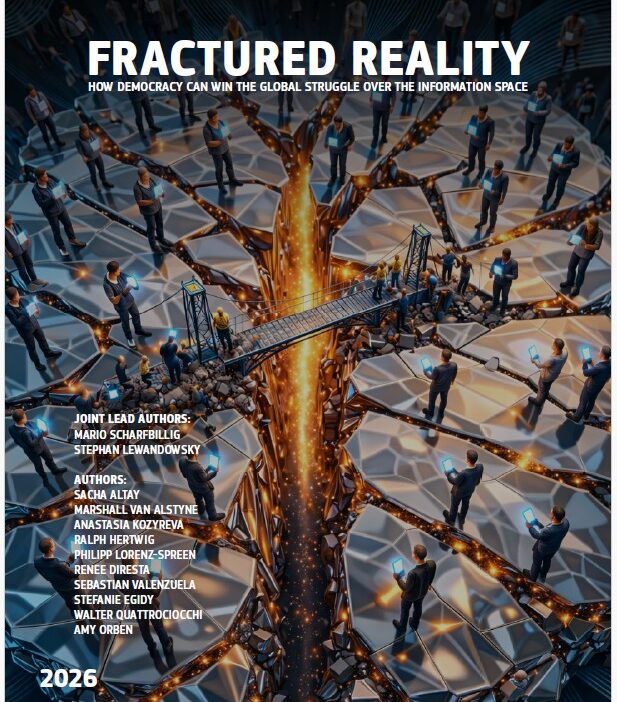
Democratic resilience is increasingly shaped by the way digital platforms organise the information space, influence what people see, and affect the formation of shared knowledge and civic debate. In Fractured Reality: how democracy can win the global struggle over the information space, a publication by the Joint Research Centre, the European Commission’s science and knowledge service, the report highlights that the digital information environment is fracturing perceived realities, weakening information integrity and placing democratic life under pressure.
At the centre of this shift is the attention economy. Many dominant online platforms rely on business models that reward engagement, scale and behavioural targeting.. In practice, this means that content which is emotional, negative, or conflict-driven tends to perform better, because it holds attention more effectively. The result is that low-quality or misleading information can circulate widely, while accurate, contextual and democratically valuable information may receive less visibility..
This is not only about what content spreads, but also about how people are shown information. Algorithms personalise feeds based on inferred preferences and past behaviour, and may reinforce selective exposure by repeatedly showing users content that corresponds to their previous engagement patterns. Over time, and under certain conditions, this contributes to echo chambers, intensify polarisation, weaker trust in institutions, and reduce shared understanding across society.
Mis- and disinformation, in this environment, are no longer straightforward. They rarely appear only as clear falsehoods. Instead, they often combine misleading claims, partial truths, and real facts. The report describes this as a shift toward a “fantasy-industrial complex,” where the effect is less about convincing people of one specific lie and more about generating confusion, distraction, and distrust in democratic institutions.
There is also a change in how people consume news. Many now encounter information passively through social media feeds, creating a “News Finds Me” effect. People may feel informed without actively checking or comparing sources. This matters because passive exposure can reduce incentives to seek out reliable information, compare viewpoints or assess the credibility of claims. As a result, fragmented and incomplete versions of reality can more easily take hold..
Democracy, the report argues, depends on something more fragile than it may appear: a shared information space. That requires a public sphere in which citizens can access reliable information, encounter a meaningful diversity of viewpoints, identify the sources and interests behind media content, and deliberate on the basis of at least some shared facts. When these conditions weaken, democratic discussion becomes harder to sustain.
The report does not present this situation as inevitable. It outlines several responses. These include addressing platform business models that depend on maximising attention, redesigning algorithms so they support democratic outcomes rather than polarisation, and giving users more control over how content is selected and recommended. It also points to the need for stronger EU digital sovereignty, given that many major platforms operate outside EU jurisdiction. Together, these measures aim to rebuild a healthier information environment and protect democratic decision-making in the digital age.
You can read the full report here: https://publications.jrc.ec.europa.eu/repository/handle/JRC144603
Trending Post
CICD (c) 2024