

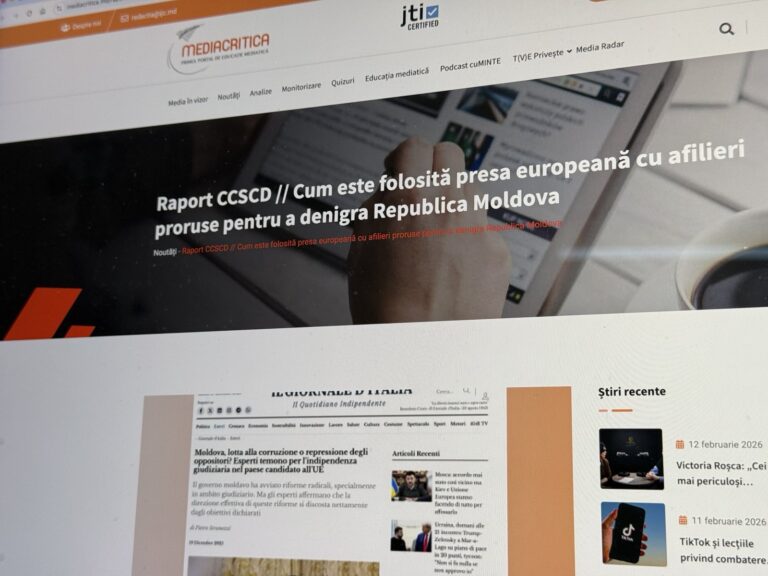
The Republic of Moldova is no longer only a target of domestic disinformation. A new report by the Centre for Strategic Communication and Countering Disinformation (CSCCD) shows that information operations aimed at discrediting the country extend into the European information environment, with the explicit goal of undermining Moldova’s image as a future member of the European Union.
According to the report, external influence campaigns seek to erode Western partners’ confidence in Moldova’s reform commitments and to present its democratic progress as simulated, selective, or politically motivated.
Western media used to legitimise hostile narratives
One significant finding of the CSCCD analysis concerns the use of Western media outlets with pro-Russian affiliations to lend credibility to narratives that are hostile to Moldova. Rather than simply appearing as foreign criticism, these narratives are structured to influence perceptions both abroad and at home. Following publication in Western outlets, they are often re-imported into Moldova’s domestic information space and presented as independent external assessments.
The report highlights that this tactic can be more effective than direct messaging from overt Russian sources, as Western outlets are typically perceived by the public as more credible and harder to dismiss as propaganda.
Case Study: Il Giornale d’Italia
A key case analysed in the CSCCD report involves the Italian publication Il Giornale d’Italia, which in December 2025 ran an article entitled “Moldova: fight against corruption or repression of opponents? Experts fear for judicial independence in the EU candidate country.”
CSCCD’s analysis shows that the article echoed recurrent narratives found in pro-Kremlin information campaigns by suggesting that Moldova’s judiciary is politically controlled and that anti-corruption efforts selectively target opposition figures. The piece also implied that the state exhibits authoritarian tendencies incompatible with European democratic standards.
A central element of the article was the case of Vladimir Plahotniuc, presented as evidence of flawed and illegitimate anti-corruption proceedings. CSCCD notes that this framing aligns with broader narratives aimed at portraying anti-corruption as a mechanism for eliminating political rivals rather than a genuine reform process. Following publication, these messages were amplified within Moldova’s domestic information space and cited as external proof of selective justice.
The report also draws attention to the article’s author, Pietro Stramezzi, who holds dual Italian and Russian citizenship and is described as a conduit for Russian narratives in Europe. According to CSCCD, these affiliations indicate a potential deliberate influence strategy exploiting Western media channels to obscure the true origin and intent of promoted messages.
“Information Laundering” and risks to democratic resilience
The Il Giornale d’Italia case illustrates a broader mechanism identified by CSCCD as “information laundering” – the use of Western media outlets to transfer credibility to hostile narratives, which are then recycled in domestic information spaces to shape public opinion and undermine confidence in institutions and Moldova’s European path.
For Moldovan audiences, this process blurs the distinction between legitimate criticism and manipulation, undermines trust in public institutions and the European integration process, and provides rhetorical leverage to actors opposed to reform. For European audiences, it poses a risk of distorting perceptions of Moldova’s democratic progress at a pivotal moment in its EU accession process.
📄 The full CSCCD report can be consulted here:
https://stratcom.md/wp-content/uploads/2026/01/Raport-MIIS-2026-1-1.pdf
📎 Source: MediaCritica – How European media with pro-Russian affiliations are used to discredit the Republic of Moldova
https://mediacritica.md/raport-ccscd-cum-este-folosita-presa-europeana-cu-afilieri-proruse-pentru-a-denigra-republica-moldova/
CICD (c) 2024