

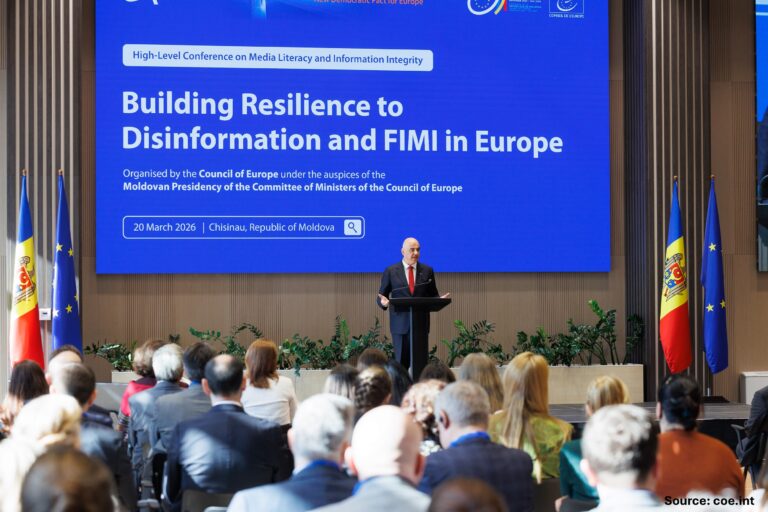
On 20 March 2026, Council of Europe brought together policymakers, experts, civil society representatives, and media professionals in Chișinău for the High-Level Conference on Media Literacy and Information Integrity: Building Resilience to Disinformation and FIMI in Europe. The event served as a platform for advancing coordinated responses to the growing challenges posed by disinformation and foreign information manipulation and interference (FIMI), both in Moldova and across Europe.
The conference highlighted the urgency of strengthening democratic resilience in an increasingly complex information environment. Participants explored how disinformation campaigns undermine public trust, distort democratic processes, and amplify social divisions.
A central highlight was the presentation of two Council of Europe guides: “The National Media and Information Literacy (MIL) Strategies: Practical Steps and Indicators” and “Resisting Disinformation: Ten Building Blocks to Strengthen Information Integrity.” These provide practical tools for governments and stakeholders to develop effective policies and improve citizens’ media literacy.
The second guide outlines ten key building blocks, including developing national strategies, strengthening research and monitoring, supporting quality journalism, safeguarding elections, promoting accountability in the digital ecosystem, upholding freedom of expression, and fostering international cooperation and trust in institutions.
During the opening, the President of the Republic of Moldova, Maia Sandu, warned about the scale of the challenge, stating that “cognitive war is a condition, not an episode”, highlighting how disinformation efforts aim to divide societies and weaken trust across Europe.
Throughout the discussions, participants underscored the importance of media and information literacy as a cornerstone of resilience. Empowering citizens to critically assess information, recognize manipulation, and engage responsibly online was identified as a long-term investment in democratic stability. At the same time, the role of independent, high-quality journalism was reaffirmed as essential for maintaining an informed public and holding power to account.
The conference also stressed the need to safeguard electoral processes from manipulation, particularly in the context of increasing digital interference.
Finally, the event reinforced the importance of international cooperation. Disinformation and FIMI are transnational challenges that require coordinated responses beyond national borders. By fostering partnerships and sharing best practices, European countries can build a more resilient and trustworthy information environment.
The conference concluded with a clear message: strengthening information integrity is not only a policy objective, but a fundamental pillar of democratic resilience. The tools and frameworks presented during the conference mark an important step forward in supporting countries like Moldova in addressing the evolving threats of disinformation while upholding democratic values and freedoms.
CICD (c) 2024