

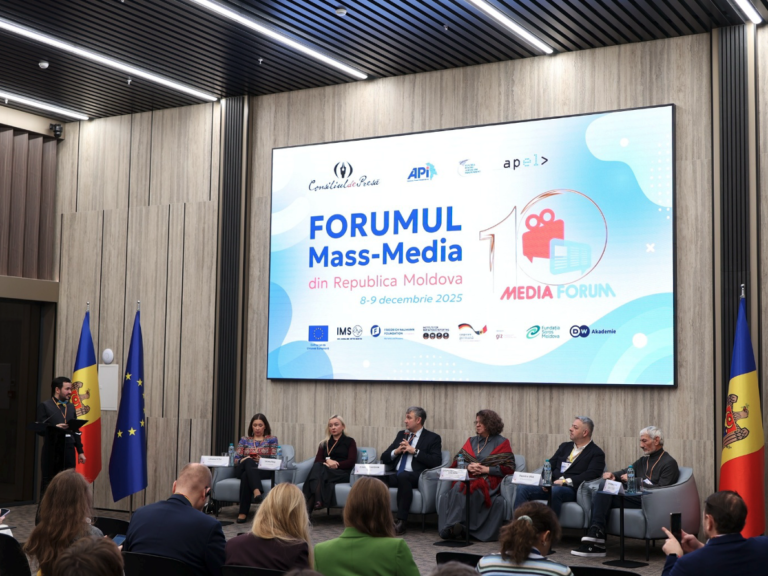
On 8–9 December 2025, the tenth edition of Moldova’s Media Forum brought together journalists, editors, media managers, policymakers, and international partners to examine the state of the country’s media ecosystem. Organised by the Press Council in partnership with the Independent Press Association (API), the Centre for Independent Journalism (CJI), and the Electronic Press Association (APEL), the Forum gathered more than 230 participants for two days of structured debates, expert discussions, and practical exchanges focused on the future of journalism in Moldova.
The Forum took place against a backdrop of growing pressure on the media sector. Economic fragility, evolving legislative requirements linked to European integration, foreign information manipulation, and the rapid expansion of digital platforms and artificial intelligence are reshaping both the risks faced by journalists and the conditions under which newsrooms operate. Within this context, the Forum served as a platform for reflection on how Moldova’s media community can strengthen its resilience and professional standards in the years ahead.
Opening the event, Press Council President Viorica Zaharia underlined the central role of independent media in countering electoral disinformation and exposing destabilisation networks. She noted that recent electoral cycles had demonstrated both the professionalism of journalists and a gradual increase in public trust in independent outlets. This assessment was echoed by the President of the Republic of Moldova, Maia Sandu, who warned of escalating threats in the global information environment, including coordinated propaganda efforts and increasingly sophisticated falsification technologies. Messages from European Union, German, and Danish representatives reinforced the view that independent media remain a key pillar of democratic resilience.
Legislative alignment and European integration were among the Forum’s core themes. Participants discussed the complexity of harmonising national media legislation with European standards, highlighting the need for predictability, transparency, and safeguards for editorial independence. Representatives of public authorities acknowledged the challenges involved, while announcing that the adoption of a new media law is planned for mid-2026. Speakers stressed that legal reform must be accompanied by consistent implementation and dialogue with the media sector to ensure meaningful impact.
Digital transformation and the growing influence of Big Tech platforms formed another major focus of discussion. Experts examined how platform governance, artificial intelligence, and algorithmic content distribution affect media freedom and information integrity. A policy handbook presented by OSCE representatives framed these challenges within a broader international context. Subsequent discussions centred on practical responses, including the implementation of the Digital Services Act, investments in cybersecurity, the establishment of innovation mechanisms for media, and the need for clearer rules to counter hate speech and online harassment.
Election coverage in the context of foreign information manipulation and interference (FIMI) was also addressed. Journalists and institutional representatives reflected on lessons learned from recent electoral campaigns, emphasising that manipulation efforts are increasingly coordinated, data-driven, and adaptive. Participants noted that newsrooms have been forced to adjust workflows and verification practices in response to the volume and sophistication of misleading content, while calling for stronger cooperation between media, state institutions, and fact-checking actors.
Economic sustainability emerged as a cross-cutting concern. Discussions highlighted persistent dysfunctions in the advertising market, where television continues to dominate while advertising revenues increasingly flow toward global digital platforms. Participants examined potential policy responses, including subsidising audience measurement systems, adjusting competition rules, and exploring fairer revenue distribution models. At the same time, speakers emphasised that long-term sustainability requires organisational development and strategic planning within media outlets themselves.
Human resource shortages in newsrooms were identified as a structural vulnerability. Media managers and academic representatives pointed to low salaries as a key factor driving skilled professionals out of journalism. Universities and public institutions presented ongoing efforts to modernise curricula and better align educational programmes with the realities of the media labour market.
The role of international support was examined from a long-term perspective. While external funding continues to play a critical role, participants agreed that donor support should increasingly focus on strengthening institutional capacity, encouraging revenue diversification, and supporting innovation rather than short-term project outputs alone.
Complementing the plenary debates, the Forum hosted practical workshops on digital storytelling, responsible use of artificial intelligence, and protection against online harassment. These sessions underscored the need for clear internal policies, effective reporting mechanisms, and safeguards against strategic lawsuits against public participation (SLAPPs).
Special sessions dedicated to local media and investigative journalism highlighted the importance of regional outlets in providing reliable information to communities and countering disinformation. Discussions also explored how investigative journalism can adapt to new formats and platforms without compromising depth and accuracy.
The Forum concluded with the presentation of the National Award for Journalistic Ethics and Professional Conduct to journalist Viorica Tătaru, the launch of a new edition of The Black Book of Waste in Public Money, and the adoption of the Media Forum 2025 Resolution. The resolution outlines key findings and recommendations aimed at improving the regulatory, economic, and professional environment in which Moldova’s media operate.
Overall, the Media Forum reaffirmed that strengthening Moldova’s media sector requires sustained cooperation between journalists, institutions, and international partners. Rather than isolated interventions, participants emphasised the importance of long-term investment in legal clarity, professional capacity, and trust-building mechanisms to ensure a resilient and credible media ecosystem.
CICD (c) 2024