

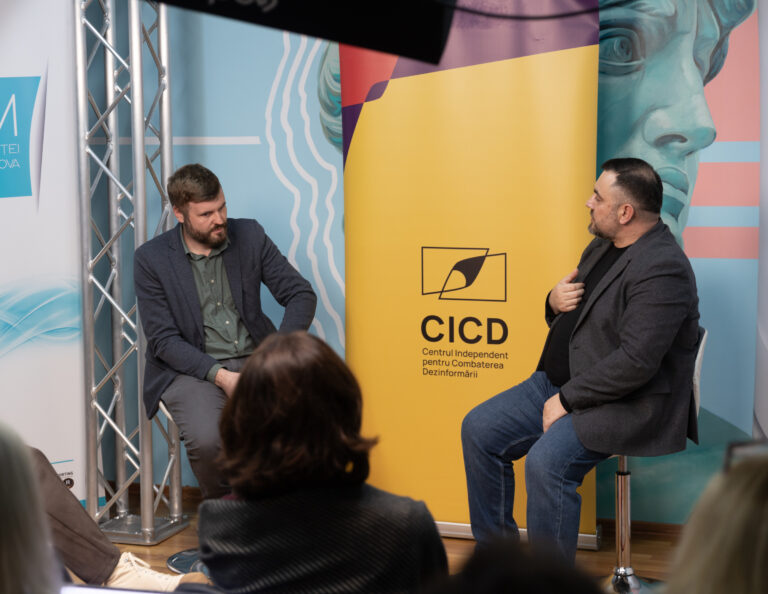
Comrat, 21 November 2025 – The Independent Countering Disinformation Centre (ICDC) held its first Discussion Club in Comrat, bringing together civil society leaders, journalists, analysts, and other partners from the ICDC network to discuss democratic processes in Gagauzia, particularly in the context of upcoming local elections. The event’s central focus was on how civil society actors can strengthen cooperation to ensure free, fair, and transparent elections in the autonomous region and generate both immediate and long-term positive impact on democracy.
Understanding the political setting and local realities
The event was hosted by an ICDC partner NOKTA.md, whose director, Mihail Sirkeli, presented the context of the upcoming elections for the People’s Assembly and the potential early election for the Bashkan. He emphasized that, although electoral monitoring efforts are important, long-term investment into local civil society is to be the priority for democratic resilience.
He warned about the persisting influence of networks linked to fugitive oligarch Ilan Shor, whose operations in Gagauzia reportedly mobilise tens of thousands of people and benefit from significant financial resources. According to Sirkeli, one of the most pressing vulnerabilities in the region’s electoral ecosystem is the illegal financing of political parties, as well as unlawful campaign-related activities and broader electoral corruption phenomena.
Mihail proposed three key areas where civil society and state must act:
· Clarifying Chisinau’s role in supporting democratic processes while avoiding accusations of political interference.
· Strengthening electoral administration, particularly following the dissolution of the local Electoral Commission.
· Safeguarding the independence of Gagauzia Radio and Television Company (GRT), the regional public broadcaster widely perceived as politically influenced.
Participants noted that the combined reluctance of local officials to cooperate with national institutions – and the ambiguous and cautious approach taken by Chisinau towards local authorities – have created a set of vulnerabilities that external actors – Russian Federation and local proxies, are exploiting.
Institutional weaknesses and electoral irregularities
Vitalie Hotnogu, Promo-LEX representative, highlighted structural deficiencies in the functioning of the regional Electoral Commission and its difficult relationship with the Central Electoral Commission. He explained that, while Moldova’s national elections operate under a unified system with clear procedures, the rules governing local elections in Gagauzia diverge from these national standards. Vitalie emphasized that local election procedures should be adjusted and harmonized with national legislation to ensure consistency and proper electoral governance.
As Hotnogu explained, these inconsistencies have facilitated documented problems, including voter bribery and weak enforcement of Central Electoral Commission warnings.
The controversial 2023 election of Bashkan Evghenia Gutsul, was cited as an example of systemic governance failures.
Hotnogu and other participants expressed solidarity and emphasised the need to align the Gagauzia Electoral Code with national legislation.
Another topic discussed was the synchronization and alignment with national standards, specifically regarding the regional public broadcaster – GRT, as part of broader reform efforts.
Identity, influence, and the power of narratives
Historian and WatchDog.md expert Stefan Bejan turned attention to the region’s information environment, describing Gagauzia as a territory where Russian influence has remained deeply entrenched for decades. He noted that Moscow’s political messaging and symbolic presence have played a major role in local elections, pointing to the overwhelmingly pro-Russian results in 2015 and 2023.
Bejan argued that while the European Union has funded significant local development projects, their impact has often been overshadowed by weak communication strategies and efforts by local elites to claim credit for personal gain. As a result, trust in European institutions has remained fragile.
He further highlighted how the status of autonomy is frequently misused by local politicians as a tool to create divergences with Chisinau, dismissing opportunities to invest in local heritage, preserve culture, and advance reforms to address real socio-economic development challenges. He also mentioned that local politicians often reinforce dependency on external influences – in particular hostile Russian narratives about Chisinau, rather than seeking social cohesion and cooperation with central authorities.
Challenges and opportunities ahead
A recurring theme throughout the event was the weakness of local, independent civil society structures. Participants observed that many young people avoid civic activism due to fear of criticism, polarisation, or direct pressure from local authorities. This has left a narrow space for pro-democratic voices to operate.
Nevertheless, several speakers noted that the current political turbulence could also serve as a catalyst for change. Increased visibility of governance problems, combined with coordinated support from national institutions and international partners, could help empower local communities and build a more resilient democratic culture.
A way forward
The Comrat Discussion Club concluded with a mix of caution and optimism. While political and institutional challenges in Gagauzia remain significant, participants identified clear avenues for action: strengthening election monitoring, promoting democracy and media literacy, enhancing institutional accountability, supporting independent local voices, and improving advocacy efforts. The event underscored that, despite external influences, institutional fragility, and entrenched political interests, a more united civil society can foster greater transparency and accountability in local democratic processes.

CICD (c) 2024