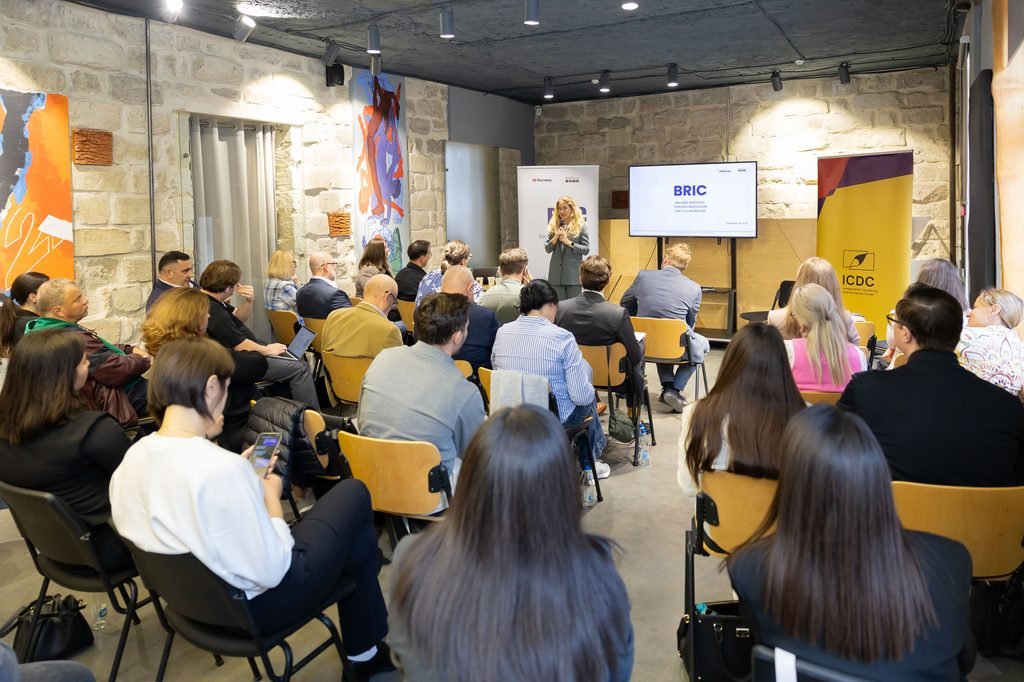
On Tuesday, 22 September, ICDC brought together its 13 member organisations for its first discussion club of the autumn. The meeting provided an opportunity to look back at the most important results achieved through the partnership with ICDC, as well as to discuss lessons learned and priorities for future development.
The event focused on the experiences of member organisations and how collaboration, and creative approaches have helped strengthen society’s resilience to disinformation.
Andrei Curăraru, an expert at WatchDog an ICDC member organisation, explained that the joint projects started from a simple challenge: how to communicate messages about information integrity and democracy to people who do not normally consume political news.
“We tried to make our voices heard,” Curăraru said, referring to experiments involving infotainment, collaborations with media organisations and the adaptation of content to different audiences.
For WatchDog, one of the key lessons was that messages about disinformation need to be adapted to the format and preferences of each audience. “A 20-page report is useful, but it needs to be ‘digested’ and transformed differently for each audience,” the expert said.
The same need to adapt messages to different audiences was highlighted by Lidia Chirova from TUK.md, a newsroom serving communities in southern Moldova and Russian-speaking audiences. “The most important result we achieved is that we managed to inform people in simple language, without fear and without manipulation,” she said.
Another example was the project carried out by Transparency International Moldova, which started from the observation that, in local communities, mayors, councillors and other influential people are important sources of information for citizens. The organisation trained communications staff from local and district authorities, who in turn trained those responsible for communication in village administrations. According to Lilia Cravcenco, the campaign reached around 900 mayoralties across the Republic of Moldova last year.
In the Transnistrian region, cooperation between the Zona de Securitate portal and WatchDog focused on collecting data that had previously been difficult to obtain. Conducting an opinion poll on the left bank of the Nistru was one of the achievements highlighted by Irina Tabaranu, Executive Director of Zona de Securitate. “We conducted an opinion poll on the left bank of the Nistru, something that, at this scale, seemed impossible in the past,” she said, noting that previous nationwide surveys included the wording “excluding the Transnistrian region.”
According to Irina Tabaranu, the survey also changed the way people’s views in the region are discussed. “Essentially, through our survey, we changed the public agenda on the left bank of the Nistru,” she said. For the first time, the data provided a basis for public discussion of the views and expectations of people living in the region.
The Gagauz newsroom Nokta demonstrated that topics such as social cohesion can also be addressed creatively and informally – even in the kitchen. The “Gustul Neamului” programme used gastronomy as a starting point for conversations about society, traditions and identity. Through recipes and culinary stories from different regions of the Republic of Moldova, the project addressed issues such as diversity and social cohesion in an accessible and interactive format.
Another experiment explored the use of humour as a communication tool to counter disinformation. The Moldova School of Journalism developed a training programme focused on storytelling and the production of sketches and reels. For Maia Metaxa, the school’s director, one of the main lessons is that resilience is built over time.
“If we want to have a major impact on society, especially in terms of resilience, this can be achieved through education. And education requires time and, above all, patience,” Metaxa said.
Taken together, these experiences illustrate the range of approaches used by ICDC member organisations: from content adapted to different audiences and cooperation between newsrooms and organisations, to surveys, training for local communicators, and the use of formats such as gastronomy and humour to reach the public.
The retrospective, however, went beyond reviewing results. The discussion also focused on how the experiences gained can be translated into long-term mechanisms for cooperation and development. Topics included strengthening the operational, technical and institutional capacities of member organisations, launching new joint initiatives and further strengthening ICDC as a platform for cooperation.